

Deep within the northern central plains of Sri Lanka lie the sprawling ruins of two ancient royal capitals that anchored the island’s golden age of civilization for over fifteen centuries: Anuradhapura and Polonnaruwa. Together, these UNESCO World Heritage cities showcase colossal brick stupas that rivaled the pyramids of Egypt in engineering scale, sophisticated hydraulic reservoirs that still irrigate local paddy fields, and exquisite granite rock sculptures. However, because both archaeological parks cover dozens of square kilometers, visiting them without a clear plan can be overwhelming. This practical guide breaks down the historical highlights, entrance fees, bicycle touring routes, and logistical tips to help you experience both ancient cities comfortably.
Understanding the Two Capitals: An Overview
To appreciate what you are seeing, it helps to understand the chronological sequence of Sri Lankan royal history:
- Anuradhapura (Capital from ~377 BCE to 1017 CE): The first and longest-enduring ancient kingdom of Sri Lanka. Anuradhapura is vast, monumental, and deeply sacred. Unlike an abandoned museum ruin, it remains an active pilgrimage site where thousands of white-clad Buddhist devotees worship daily at 2,000-year-old stupas and around the sacred Bodhi tree.
- Polonnaruwa (Capital from 1070 CE to 1215 CE): Established as the royal seat after south Indian Chola invasions displaced Anuradhapura. Polonnaruwa is more compact and architectural in feel, featuring well-preserved royal palace foundations, council chambers, and the world-famous rock-carved Buddha figures of Gal Vihara. It was occupied for roughly two centuries, making its ruins easier to navigate in a single morning.
Exploring Anuradhapura: The Sacred City
The ruins of Anuradhapura cover over 40 square kilometers. A sensible visit focuses on the most significant monuments, known historically as the Atamasthana (Eight Sacred Places):
1. Jaya Sri Maha Bodhi
Planted in 288 BCE from a southern sapling of the historical Bodhi tree in Bodhgaya, India under which Siddhartha Gautama attained enlightenment, this is the oldest historically authenticated, human-planted tree in the world with a continuous written record. Surrounded by golden railings and prayer flags, the sacred tree is cared for by hereditary Buddhist guardians and receives thousands of pilgrims daily.
2. Ruwanwelisaya Dagoba
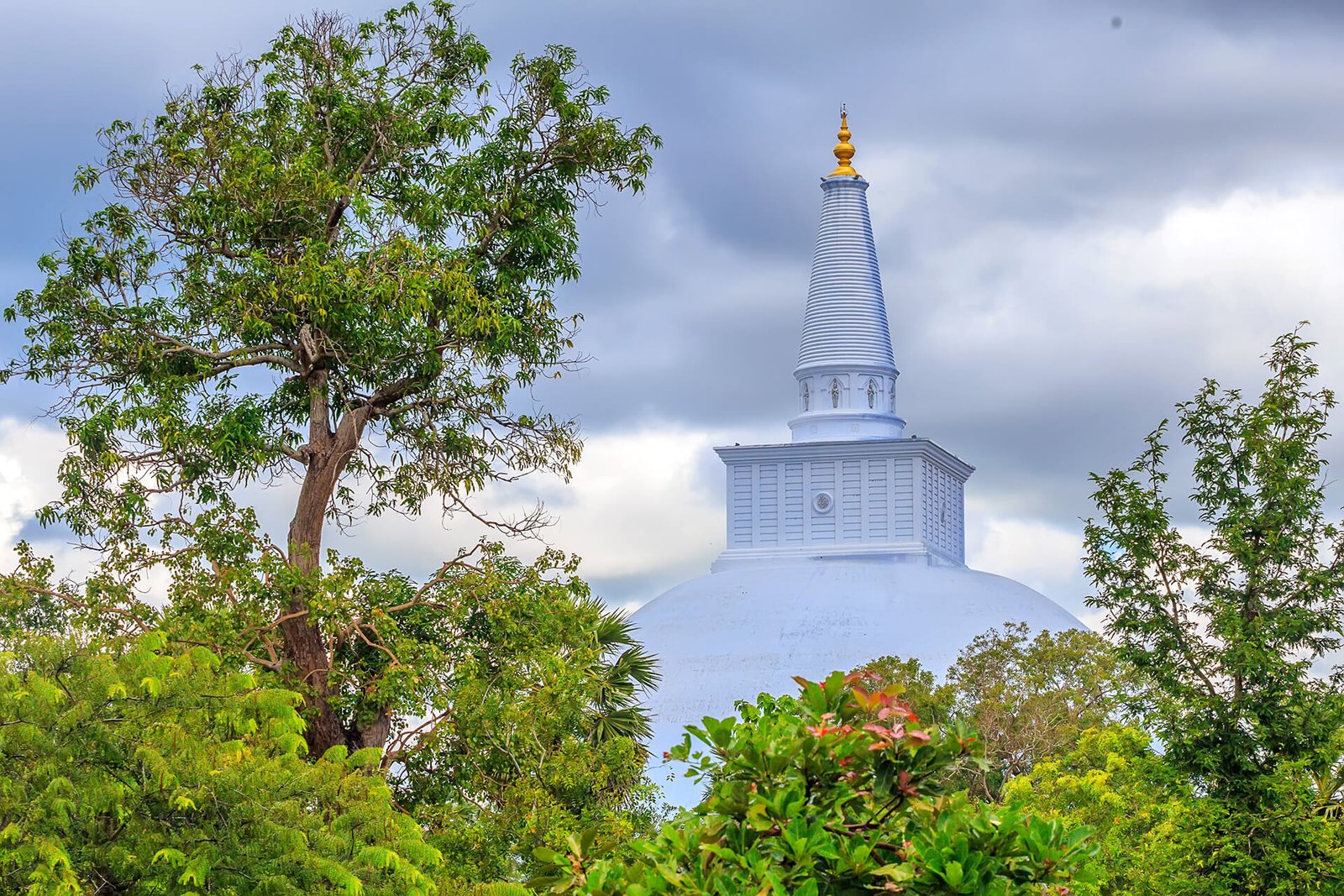
Built by King Dutugemunu in 140 BCE, this colossal white stupa stands 103 meters tall with a circumference of 290 meters. The base is protected by a famous outer wall featuring hundreds of carved elephant relief sculptures standing shoulder to shoulder. In the evening, the white dome is illuminated by spotlights while monks chant in the paved courtyard.
3. Jetavanaramaya and Abhayagiri Dagobas
Jetavanaramaya was the third-tallest structure in the ancient world when constructed in the third century CE, surpassed only by the Great Pyramids of Giza. Built using over 93 million baked clay bricks, it represents a staggering feat of ancient brick masonry. Nearby Abhayagiri stupa was the center of a monastic university that once housed 5,000 international scholars, documented by the Chinese traveler-monk Faxian in 412 CE.
4. The Twin Ponds (Kuttam Pokuna) and Samadhi Buddha
The Twin Ponds are stone-lined ritual bathing pools constructed for Buddhist monks, featuring sophisticated underground water filtration conduits and decorative stone dragonhead spouts. Nearby sits the Samadhi Buddha, a fourth-century dolomite marble sculpture depicting the Buddha in deep meditation, widely considered the finest classical sculpture in Sri Lanka.
5. Isurumuniya Rock Temple and Ranmasu Uyana
Located south of the sacred reservoir Tissa Wewa, Isurumuniya is a rock-hewn monastery famous for its exquisite fifth-century carvings. The most celebrated relief is the “Isurumuniya Lovers,” depicting Prince Saliya (son of King Dutugemunu) who famously gave up his right to the throne to marry Asokamala, a maiden from a lower caste. Directly adjacent lies Ranmasu Uyana, the Royal Pleasure Gardens, which contains the intriguing ‘Sakwala Chakraya’ (carved astronomical petroglyph) and ancient stone pavilions surrounded by terraced lily ponds.
6. Mihintale: The Cradle of Sri Lankan Buddhism
Located just 12 kilometers east of Anuradhapura, Mihintale is regarded as the historic cradle where Buddhism was first introduced to King Devanampiya Tissa by Arahat Mahinda (son of Emperor Ashoka of India) in 247 BCE. Climbing the 1,840 wide granite steps shaded by frangipani trees leads to a dramatic high plateau. Highlights include the ancient monastic hospital ruins at the mountain base, the towering Ambhasthala Dagoba, and the thrilling scramble up Aradhana Gala (Meditation Rock), which rewards visitors with a breathtaking 360-degree panorama of the forested plains at sunset.
| Ancient City | Anuradhapura | Polonnaruwa |
|---|---|---|
| Historical Era | 4th Century BCE – 11th Century CE | 11th Century CE – 13th Century CE |
| Foreign Adult Ticket | US $30 (approx. 9,500 LKR) | US $30 (approx. 9,500 LKR) |
| Time Required | Full day (5 – 6 hours) | Half day (3 – 4 hours) |
| Best Way to Explore | Private car between major sites | Bicycle or private car |
| Atmosphere | Active, sacred pilgrimage center | Compact, archaeological park |
Exploring Polonnaruwa: The Medieval Capital
Polonnaruwa is located roughly 65 kilometers east of Anuradhapura. The archaeological park is enclosed and surrounded by the massive Parakrama Samudra (the ‘Sea of Parakrama’), an artificial irrigation reservoir covering 2,500 hectares built by King Parakramabahu I in the twelfth century.
Key Monuments in Polonnaruwa
- The Royal Palace of Parakramabahu I: An imposing seven-story brick palace complex that originally contained a thousand chambers. Today, massive three-story brick walls with beam holes and royal bathing pools survive.
- The Sacred Quadrangle (Dalada Maluwa): A raised stone terrace containing twelve ancient monuments, including the circular Vatadage shrine with its moonstones and guardstones, the Hatadage tooth relic shrine, and the Gal Pota (Stone Book), a 25-ton inscribed granite monolith.
- Rankoth Vehera: The largest completed stupa in Polonnaruwa, standing 55 meters tall, built entirely of red brick in the architectural style of Anuradhapura.
- Gal Vihara (The Rock Temple): The pinnacle of ancient Sri Lankan granite sculpture. Carved from a single vertical slab of gneiss rock, the site features four magnificent Buddha statues: a seated Buddha in meditation, a smaller seated figure inside an artificial cave, a 7-meter standing figure with folded arms, and an enormous 14-meter reclining Buddha depicting the Buddha entering Parinirvana.
Bicycle Touring in Polonnaruwa
Unlike Anuradhapura, which is too vast and hot to explore entirely on a bicycle, Polonnaruwa is flat, shaded by tall trees, and compact, making it ideal for bicycle touring. High-quality multi-gear bicycles can be rented near the entrance museum for approximately 1,500 to 2,000 LKR ($5 – $7 USD) per day. The roads between the Royal Palace, the Quadrangle, and Gal Vihara are paved and scenic.
Crucial Dress Codes and Temple Etiquette
Both ancient cities are active Buddhist religious sites, and standard temple etiquette applies throughout:
- Modest Clothing: Cover shoulders and knees. Light, breathable white clothing is strongly recommended.
- Footwear Removal: You must remove your shoes and hats whenever you step onto the paved stone platforms surrounding stupas and image houses. Because stone paving can become intensely hot under the midday sun, wearing clean white socks can help protect your feet from heat while complying with etiquette rules.
- No Posing Back-to-Buddha: Never stand with your back facing a Buddha statue to take a photo. When photographing friends, position them to the side of the image facing toward it.
How to Structure Your Visit on a Private Tour
We recommend dedicating two days to explore both capitals without fatigue:
- Day 1: Drive from Colombo or Negombo to Anuradhapura. Spend the afternoon visiting the sacred Sri Maha Bodhi tree and Ruwanwelisaya at sunset when the temple courtyards come alive with evening chanting.
- Day 2: Explore the remaining Anuradhapura monasteries in the morning, then drive 1.5 hours to Habarana. In the afternoon or next morning, explore the ruins of Polonnaruwa by bicycle, followed by a visit to Gal Vihara.
